Sprint 1 · Days 1–30 — Diagnosis and Buy-In
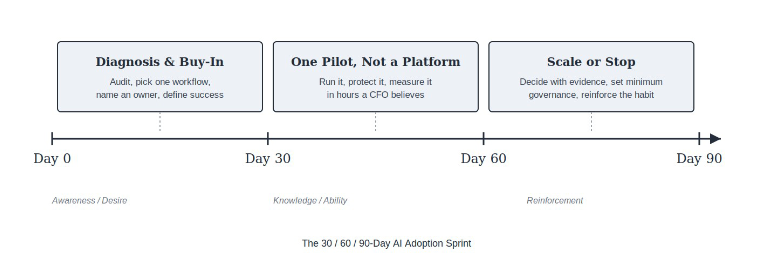
The most common mistake in the first month of an AI initiative is buying something. A demo goes well, someone signs the pilot licence, and the company now owns a tool before it owns a workflow, an owner, or any definition of what success looks like. That tool typically survives about six weeks of real use before it quietly stops being opened. The first thirty days aren’t for deployment. They’re for diagnosis.
Start by auditing what’s already happening, because most of the answer is already inside the building. Three places are worth an honest look. Shadow use first — people are almost certainly already running ChatGPT or Copilot on personal accounts for parts of their job, which is free market research on where the appetite and the friction already sit, gathered without a procurement process. Existing spend second — plenty of SMBs are already paying for AI features bundled into a CRM, a helpdesk, or a writing tool bought for something else, and using none of it; find out what’s already been paid for before buying more. And the two or three highest-friction workflows third — not the most exciting ones. The task eating the most recurring hours, or the one that reliably causes delays, is a better starting point than whatever looks most impressive in a pitch deck.
For a more structured way to source and score candidates than a single afternoon of asking around, see the Use Case Analysis series.
Resist forming a committee. It feels like the responsible move, and it’s usually where momentum goes to die — a committee spreads accountability thin enough that nobody actually owns the outcome, and it meets on a cadence slower than the sprint itself allows. The blunter, more effective move: name one person, ideally someone close to the actual workflow rather than a senior executive three layers removed from it, and give them real authority to run the pilot in phase two. One name on the deliverable beats one more recurring meeting.
Before shopping for anything, answer one deceptively simple question: what would you measure at day 90 if this worked? Not “efficiency,” not “innovation” — a number. Hours saved on a specific task, a turnaround time cut from days to hours, a backlog that stops growing. If nobody in the room can answer that in one sentence, the initiative isn’t ready to leave phase one, whatever a vendor’s demo just promised.
One more decision is worth surfacing now rather than discovering it later: whether the eventual solution should run on open-source, self-hosted components or a proprietary vendor stack. That’s not a technical detail to defer to IT in month three — it shapes what you can actually afford to scale in phase three, and what happens to your data and your costs the day a vendor changes its pricing. It doesn’t need an answer yet. It needs to be asked out loud.
By the end of day 30, four things should be true:
- One workflow is named, and it’s a real source of recurring friction rather than the flashiest option in the room.
- One person owns it, with real authority to run the pilot.
- Success is defined as a specific number, agreed before any tool gets chosen.
- No purchase has been made.
If all four hold, the sprint moves into phase two — a single, protected pilot.