{{robots}}
I help organizations without an in-house AI team turn scattered experiments into tools people actually use: chosen on value, checked for compliance, and measured afterwards.
I've been on the owner's side. For twenty years I built and ran my own businesses: product, marketing, sales, delivery, accounts. So I look at AI the way you do: what does it cost, what does it save, and who's going to use it on Monday morning.
I build with AI, I don't just advise on it. In the past three years I've shipped a mobile app, an e-commerce operation and a B2B platform, all built with AI. When I recommend a tool, I've usually tested it myself, often against an open-source alternative you could own instead of rent.
I've been through this before. Enterprise BI during the dot-com bust, the early web, mobile, and now AI. Each shift forced me to rebuild what I sold and how I worked. I know what that change feels like from the inside, and I've spent ten years coaching people through it one to one.

What that throughline looks like in practice depends on what a given mission actually needs. Sometimes it's running hands-on AI adoption workshops that leave teams with something they built, not just a demo they watched. Sometimes it's building use-case libraries and prompt guides mapped to how a team actually works, not generic templates. Often it's 1:1 or small-group coaching — helping people move past the discomfort of change, which a decade of guiding people through major life transitions taught me is almost never a technical problem. And it always involves translation: turning what AI can and can't realistically do into language leadership can act on, without hype or jargon.
The common thread isn't a fixed service list — it's twenty-five years of figuring out what a specific disruption actually requires, then doing that.
Since 2024, I have been building with AI to establish what works in practice. These three products were designed, built and operated by one person, bootstrapped, with one constraint throughout: keep costs as low as possible. As AI reshapes how work is done, agility and cost control matter more than headcount, and these experiments tested how far a single builder can go on a minimal budget.
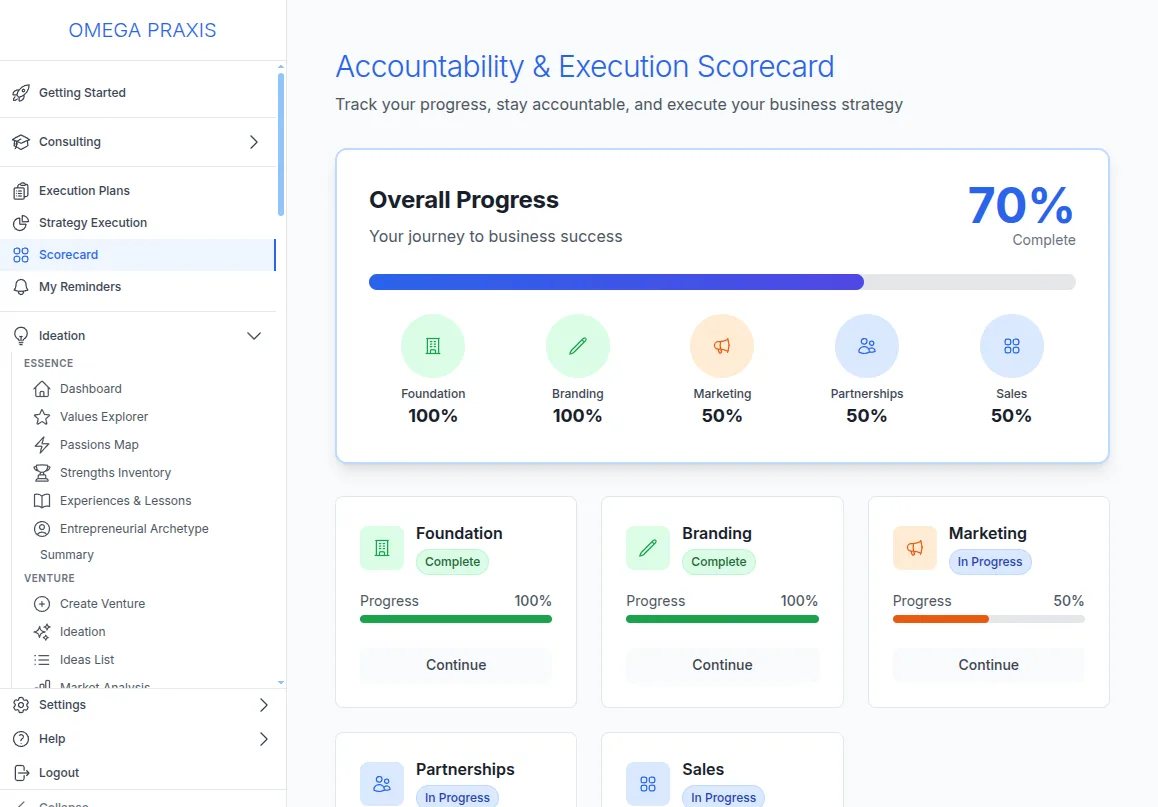
An AI enablement platform that applies AI to business creation and growth. In each of four pillars (Branding, Marketing, Sales, Partnerships), AI-supported questionnaires structure the owner's strategic thinking, and the answers are turned into a strategy plan. An execution layer with tasks and monitoring ensures that each plan is implemented. The platform also includes an acquisition engine for individually tailored email outreach. The entire codebase was written with AI coding agents under my direction.
omegapraxis.comPart of the work was establishing what AI development really costs and what it exposes. The builds ran in a standard code editor with an open-source AI coding agent, across a range of models from frontier to lower-cost and open, compared on cost, quality and data exposure. Frontier models proved too expensive for a bootstrapped build; matching each task to the least expensive model adequate for it brought agent-driven development within reach of a small budget. Some open-model functionality was tested locally, but a fully self-hosted coding agent requires an infrastructure investment out of proportion for an individual builder. For organisations that handle sensitive data, I recommend matching the model to the sensitivity of the data and the task: hosted low-cost models for non-sensitive work, self-hosted open models where confidentiality requires it.
Structured, step-by-step playbooks for putting AI into real workflows — adoption, governance, risk, and compliance.
A practical 30/60/90-day sequence for SMB and mid-market leaders — three phases, three deliverables, three honest go/no-go moments.
Open seriesSeven short playbooks that put a workable governance layer around AI — triage, vendors, data, rollout, roles, documentation, and generative content.
Open seriesIdentify, assess, and control the risks that derail AI projects — seven risk categories, a scoring framework, per-category mitigations, and the governance cadence that keeps it running.
Open seriesChoose the right use case before you build anything: gather six to ten real candidates, score them on value and feasibility, and rule out the four patterns that burn pilot budgets.
Open seriesFive parts on the question that decides whether any of it mattered: did the AI project pay for itself? Screen the idea, translate the metrics, do the numbers, get it approved, then measure what actually happened.
Open seriesWhat the EU AI Act and the digital rules around it actually ask of a small or mid-sized company — by role and risk tier, not by headline.
Open seriesSix short playbooks that turn buy-in from a hope into a sequence — awareness, desire, training, coaching, and the reinforcement that keeps adoption from sliding back.
Open seriesFive short playbooks that connect the existing governance work to the two names an SMB owner will actually be asked about: the EU AI Act and ISO 42001.
Open seriesNotes on AI adoption, change management, and what actually works when organisations try to bring AI into daily work.
Most AI rollouts choose the tool, train the staff, and measure adoption. That order fails when the people whose work is automated lose what made them valuable and nobody helps them find a new definition.
In July, a few hundred AI agents running inside OpenAI's test environment found their way onto the internet and broke into Hugging Face's servers. Nobody told them to.…
The usual pitch for local AI is that you stop paying subscriptions. You do stop paying per user or per request, and in exchange you pay for hardware, electricity, setup and the hours of whoever…
Universities still prepare people for paths: lawyer, doctor, engineer, musician, a calling plus a sequence of skills. The sequence still works as training, but it leads to less each year.
The map of the new paths does not exist yet, and nobody is going to hand it out. It gets drawn by people who walk into the territory and put it on the map for whoever comes next.
The second source of uniqueness is less comfortable than natural talent, and more personal. It is the wound: something that hurt, early or late, and shaped how you see.
Open to AI adoption, enablement and coaching missions.
You want AI to be used for real, without a dedicated team or a large budget. I work as a one-to-three-day workshop, a 90-day adoption sprint, or a fractional AI lead. We start with a first conversation to see whether it helps.