The 30/60/90-Day AI Adoption Sprint: A Structure, Not a Slogan
A practical adoption structure for SMB and mid-market leaders
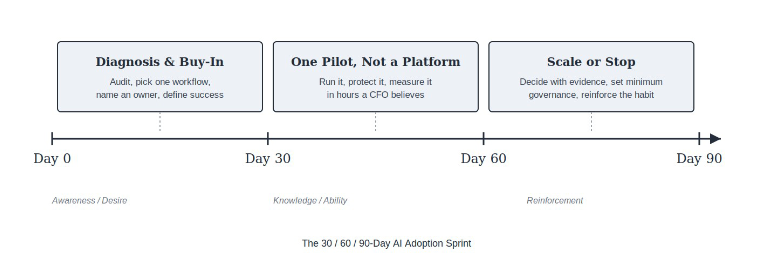
Most small and mid-sized companies don’t fail at AI adoption because they chose the wrong tool. They fail because nothing forced a decision. One version of this: someone raises AI in a leadership meeting, a vendor books a demo, a subscription gets signed, and three months later nobody can point to what actually changed. The other version: the topic circulates as a standing agenda item for two quarters and never converts into anything at all. Different failure, same cause — no structure was forcing the organisation to move.
The fix isn’t a better tool. It’s borrowing a format that already works for the same reason in a different context: the 30/60/90-day plan used in executive onboarding for decades, precisely because fixed checkpoints force a decision instead of letting one drift. Applied to AI adoption, it does the same job — three checkpoints, three deliverables, three honest go or no-go moments, instead of an initiative with no edges that can quietly run forever.
Each of the three phases answers exactly one question, and answering more than one at a time is the most reliable way to waste the first quarter. Days 1 to 30 answer where this actually applies and who owns it — diagnosis, not deployment; nothing gets purchased yet, and the deliverable is one named workflow, one accountable owner, and a definition of what “worked” will mean at day 90. Days 31 to 60 answer whether it works, in hours you can count — a single protected pilot on the workflow chosen in phase one, not three use cases running in parallel because momentum built up in the meantime. Days 61 to 90 answer whether you scale it and how you stop it from quietly decaying afterward — an explicit expand, fix, or stop decision, plus the minimum governance a thirty-to-a-hundred-fifty-person company actually needs, not a framework built for a listed enterprise several sizes larger.
What this series won’t do is tell you which platform to buy. That’s deliberate on two counts: the sequence works whether you land on an open-source, self-hosted stack or a commercial one, and any specific tool recommendation in a piece like this is usually half-stale by the time someone reads it. It’s also not written for a company with a dedicated AI or innovation function — those exist, but they’re not who stalls. This is written for the company where the CEO, the COO, or a couple of operators are running the sprint alongside everything else already on their plate, which means every step in it has to survive limited time and no dedicated budget line.
The next three pieces walk through each phase in order — what to audit and decide in the first thirty days, how to run one pilot properly in the next thirty, and how to make the scale-or-stop call, with just enough governance, in the final thirty. Each one closes with a short checklist: what should be true by the end of that phase if the sprint is actually working, not just running.
The one-page tracker
Every checklist from the three phases on a single page. Print it, or copy it into whatever the project lives in, and mark each line as it becomes true.
| Checkpoint | Deliverable | Done? |
|---|---|---|
| Day 30 | One workflow named (real friction, not the flashiest option) | ☐ |
| Day 30 | One owner named, with real authority | ☐ |
| Day 30 | Success defined as a specific number | ☐ |
| Day 30 | No purchase made yet | ☐ |
| Day 60 | Pilot ran on that one workflow, full 30 days | ☐ |
| Day 60 | Usage data exists, not just a general impression | ☐ |
| Day 60 | Real hours-saved/reallocated figure captured | ☐ |
| Day 60 | Friction points written down | ☐ |
| Day 90 | Explicit scale / fix / stop decision made and written down | ☐ |
| Day 90 | Data, ownership, and access questions answered in writing | ☐ |
| Day 90 | A real number reported upward, with its baseline | ☐ |
| Day 90 | Someone named owns what happens next | ☐ |